Frequency Plans
A frequency plan is the set of LoRaWAN radio parameters the server uses to work with a device: which frequencies the device sends uplinks on, which frequency and data rate the server uses to reply in the RX1 and RX2 receive windows, which data rates (DR) are allowed and how many bytes fit into a frame. The web interface and the WebSocket API call a plan a region.
ONS has 38 plans with codes 0–37. The default plan is KZ865-868 (code 6).
Where the plan is set
- For a device — the "Region" field of the node card, in the "Advanced" mode (see Nodes); in the WebSocket API — the
regionfield (see Region codes). - For a multicast group — the "Region" field of the group page (see Multicast Groups); in the WebSocket API — the
regionfield of the group create and update commands. In the current server version these commands accept only codes 0–23 and write 0 (EU) when theregionfield is missing, see Create multicast group. - A gateway has no plan. A gateway receives and transmits on the frequencies of its own configuration. For the server to get device uplinks and reply to them, the gateway must listen on all uplink channels of their plan and transmit on the RX1 and RX2 frequencies, see Gateway setup.
- An application has no plan either: one application can hold devices of different plans.
The plan in the card must match the plan in the device firmware: the default channel frequencies are set in the firmware and the server cannot change them over the air. After the region in the card is changed, the server works out the RX1 window from the new plan and brings the device RX2 frequency and data rate and its optional channels to the new plan with the RXParamSetupReq and NewChannelReq MAC commands; the values set in the "Radio parameters" panel of the node card stay in force. Until the device confirms the new RX2 parameters or goes through OTAA activation again, the server replies in the RX2 window on the previous frequency and at the previous data rate, see Radio parameters and the MAC command log.
How the server uses the plan
Uplink channels
Plan channels are either default or optional; not every plan has optional channels. The device knows the default channels from its firmware. The server tells the device about the optional channels during OTAA activation — in the CFList channel list of the Join Accept. CFList holds at most five frequencies: if a plan has six optional channels (EU433, AS923-1…4, KR920), the device learns about the first five in table order.
A device with ABP activation gets no Join Accept. When such a device comes online for the first time (the "Seq up" counter in the node card is 0), the server itself sends it the plan optional channels — the same ones as in CFList — with NewChannelReq MAC commands. A custom channel set that replaces the plan optional channels for an OTAA or ABP device is entered in the "Extra channels" field of the node card, see Nodes.
US915 and AU915 work differently: the band has 72 channels and a plan enables a part of them — a sub-band. In the Join Accept the server sends a mask of enabled channels instead of frequencies, see US915 and AU915. The server does not use the NewChannelReq command or the "Extra channels" field in these plans.
Window selection
The server sends a reply to a device — a downlink frame or a Join Accept — in one of the two receive windows. The window is set by the "Rx window" field of the node card (rx_window in the WebSocket API): RX1, the default, or RX2. If RX1 is selected and a downlink frame can no longer make it, the server sends it in RX2. In the current server version a late Join Accept goes out at the RX2 window time but on the RX1 window frequency and at its data rate, see Device Activation.
To a class C device the server sends a queued frame at once, without waiting for an uplink, on the RX2 window frequency and at its data rate, see Device classes.
RX1 window
The RX1 window opens 1 s after the uplink; for a single device the delay is changed by the "RX1 delay" field of the node card. The RX1 frequency is the uplink frequency, except for US915 and AU915: there the server replies on one of eight channels 923.3–927.5 MHz — 923.3 + 0.6 × (uplink channel number modulo 8) MHz.
The server takes the RX1 data rate from the plan table using the uplink data rate and the "RX1 DR offset". In all plans the default offset is 0: in RX1 the server replies at the uplink data rate, and in US915 and AU915 — at the matching data rate of a 500 kHz channel.
If a device sent an uplink on a frequency that is not among the plan channels, or at a data rate that this channel does not allow, the server cannot work out RX1 and replies in the RX2 window. In US915 and AU915 the server checks the frequency against all 72 channels of the plan table, not only the sub-band. A channel from the "Extra channels" field does not become part of the plan: if its frequency is not among the plan channels, the server replies in RX2 to an uplink on such a channel as well. This rule does not apply to the Join Accept, see OTAA activation.
In the current server version the server does not reply to an uplink at a data rate the plan does not have at all (for example, SF7, 250 kHz in IN865-867) or to an uplink with FSK or LR-FHSS modulation.
RX2 window
The RX2 window opens 1 s after RX1, by default 2 s after the uplink. A plan has one RX2 frequency and data rate for all channels, see the tables below. For a single device they are changed by the "RX2 frequency, Hz" and "RX2 data rate (DR)" fields of the node card.
OTAA activation
The device waits for the Join Accept 5 s (RX1 window) and 6 s (RX2 window) after the request. For the Join Accept the server takes the window frequencies and data rates from the plan only: the "RX2 frequency, Hz", "RX2 data rate (DR)", "RX1 DR offset" and "RX1 delay" fields of the node card do not apply to it, see Device Activation. If the request frequency is not in the plan table or the request data rate is not allowed on that channel, the server does not move the Join Accept to the RX2 window: in the RX1 window it goes out on the frequency of the first channel in the plan table, and in US915 and AU915 — on 923.3 MHz.
Data rate and payload size
The data rate sets the spreading factor (SF) and the channel bandwidth. The lower the data rate, the longer the range and the fewer bytes fit into a frame. The limit depends on the plan and the data rate, see Data rates and payload size; the server rejects a downlink frame above the limit, see Downlink — get maximum data size.
Transmit power
The gateway sends replies at the plan default power: 14 dBm, 20 dBm in US915 and AU915, 27 dBm in IN865-867 and IN865+KZ865. In the current server version the power field of downlink commands does not change this power: the server only checks that the value is not above 27 dBm, see Downlink — queue data for sending.
The Frequency plans screen
The "Frequency plans" menu item opens a reference of all plans. It is available to any user and only shows the parameters — a plan cannot be changed here.
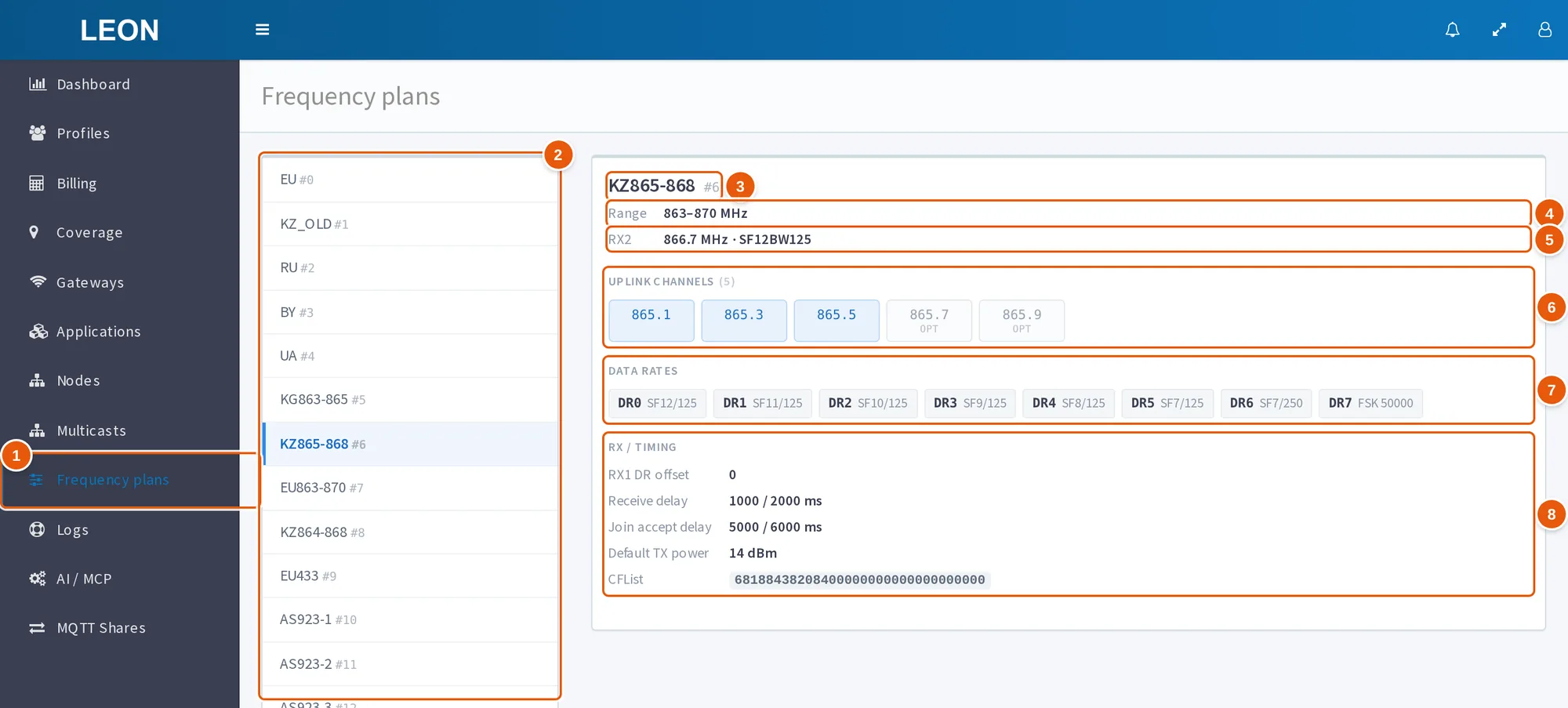
- "Frequency plans" — the menu item.
- Plan list — the plan name and code, for example "KZ865-868 #6". Clicking a plan shows it on the right.
- Name and code of the selected plan.
- "Range" — the plan limits, MHz.
- "RX2" — the RX2 window frequency and data rate.
- "Uplink channels" — the channel frequencies. Default channels are highlighted, optional ones are marked "opt".
- "Data rates" — the data rate number, SF and bandwidth, kHz; for FSK — the bit rate, bit/s.
- "RX / Timing" — "RX1 DR offset", "Receive delay" of RX1 and RX2, "Join accept delay", "Default TX power" and CFList — the channel list as the server sends it in the Join Accept (16 bytes in hex): the optional channel frequencies, or the mask of enabled channels for US915 and AU915.
For US915 and AU915 the screen shows all 72 channels of the server plan table, not only the sub-band channels; the highlighting and the "opt" mark of these plans do not show whether a channel is enabled. The enabled channels are listed in the US915 and AU915 tables. In the current version the screen shows the LR-FHSS data rates (DR5 and DR6 in US915, DR7 in AU915) as "SF/0".
Hint in the node card
The info icon next to the "Region" field of the node card and of the multicast group page opens the "Frequency plan" pop-up — a brief description of the selected plan: range, RX2, uplink channels and data rates.
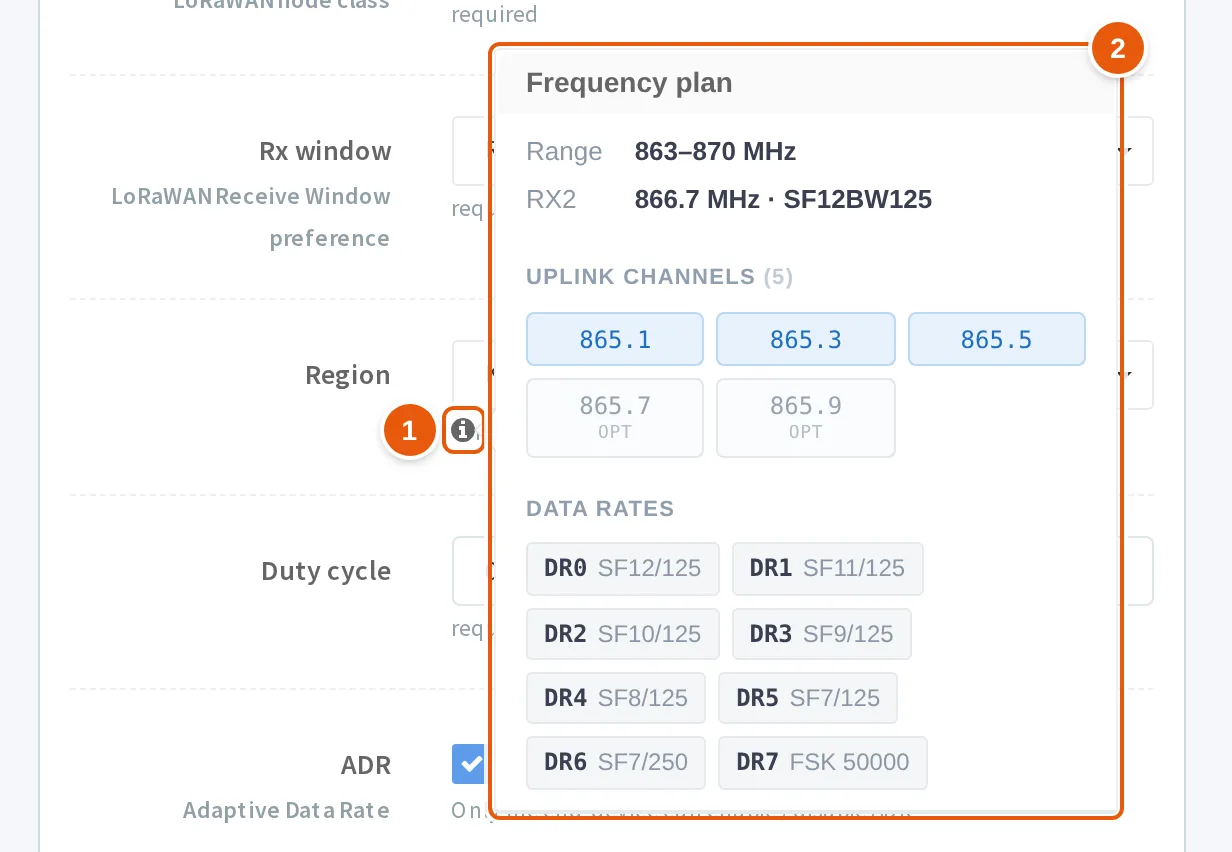
- Info icon next to the "Region" field.
- "Frequency plan" pop-up for the selected region.
All plans
Optional channels are marked "opt.". For US915 and AU915 the table gives the numbers of the enabled channels and their frequencies according to the LoRaWAN Regional Parameters specification.
The "Plan limits" in the plan descriptions below and the "Range" line on the Frequency plans screen are the frequency limits the server accepts for a device of this plan: the "RX2 frequency, Hz" and the frequencies in the "Extra channels" field of the node card must lie within them, and so must the freq frequency in WebSocket API and MQTT downlink commands. The limits do not affect uplink reception.
| Code | Plan | Uplink channels, MHz | RX2, MHz | Default TX power, dBm |
|---|---|---|---|---|
| 0 | EU | 868.1, 868.3, 868.5 | 869.525, DR0 | 14 |
| 1 | KZ_OLD | 864.5, 864.7, 864.9; opt.: 865.1, 865.3 | 865.6, DR0 | 14 |
| 2 | RU | 868.9, 869.1; opt.: 864.1, 864.3, 864.5, 864.7, 864.9 | 869.1, DR0 | 14 |
| 3 | BY | 868.1, 868.3, 868.5 | 869.525, DR0 | 14 |
| 4 | UA | 868.1, 868.3, 868.5 | 869.525, DR0 | 14 |
| 5 | KG863-865 | 864.1, 864.3, 864.5; opt.: 863.7, 863.9 | 869.1, DR0 | 14 |
| 6 | KZ865-868 | 865.1, 865.3, 865.5; opt.: 865.7, 865.9 | 866.7, DR0 | 14 |
| 7 | EU863-870 | 868.1, 868.3, 868.5; opt.: 867.1, 867.3, 867.5, 867.7, 867.9 | 869.525, DR0 | 14 |
| 8 | KZ864-868 | 865.1, 865.3, 865.5; opt.: 865.7, 865.9, 864.5, 864.7, 864.9 | 866.7, DR0 | 14 |
| 9 | EU433 | 433.175, 433.375, 433.575; opt.: 433.775, 433.975, 434.175, 434.375, 434.575, 434.775 | 434.665, DR0 | 14 |
| 10 | AS923-1 | 923.2, 923.4; opt.: 923.6, 923.8, 924.0, 924.2, 924.4, 924.6 | 923.2, DR2 | 14 |
| 11 | AS923-2 | 923.2, 923.4; opt.: 923.6, 923.8, 924.0, 924.2, 924.4, 924.6 | 923.2, DR2 | 14 |
| 12 | AS923-3 | 916.6, 916.8; opt.: 916.0, 916.2, 916.4, 917.0, 917.2, 917.4 | 916.6, DR2 | 14 |
| 13 | AS923-4 | 923.2, 923.4; opt.: 923.6, 923.8, 924.0, 924.2, 924.4, 924.6 | 923.2, DR2 | 14 |
| 14 | KR920 | 923.2, 923.4; opt.: 923.6, 923.8, 924.0, 924.2, 924.4, 924.6 | 923.2, DR2 | 14 |
| 15 | US915-1 | channels 0–7 (902.3–903.7) and 64 (903.0) | 923.3, DR8 | 20 |
| 16 | US915-2 | channels 8–15 (903.9–905.3) and 65 (904.6) | 923.3, DR8 | 20 |
| 17 | US915-3 | channels 16–23 (905.5–906.9) and 66 (906.2) | 923.3, DR8 | 20 |
| 18 | US915-4 | channels 24–31 (907.1–908.5) and 67 (907.8) | 923.3, DR8 | 20 |
| 19 | US915-5 | channels 32–39 (908.7–910.1) and 68 (909.4) | 923.3, DR8 | 20 |
| 20 | US915-6 | channels 40–47 (910.3–911.7) and 69 (911.0) | 923.3, DR8 | 20 |
| 21 | US915-7 | channels 48–55 (911.9–913.3) and 70 (912.6) | 923.3, DR8 | 20 |
| 22 | US915-8 | channels 0–7 (902.3–903.7), 56–63 (913.5–914.9) and 71 (914.2) | 923.3, DR8 | 20 |
| 23 | US915-9 | channels 0–15 (902.3–905.3) and 64 (903.0), 65 (904.6) | 923.3, DR8 | 20 |
| 24 | AU915-1 | channels 0–7 (915.2–916.6) and 64 (915.9) | 923.3, DR8 | 20 |
| 25 | AU915-2 | channels 8–15 (916.8–918.2) and 65 (917.5) | 923.3, DR8 | 20 |
| 26 | AU915-3 | channels 16–23 (918.4–919.8) and 66 (919.1) | 923.3, DR8 | 20 |
| 27 | AU915-4 | channels 24–31 (920.0–921.4) and 67 (920.7) | 923.3, DR8 | 20 |
| 28 | AU915-5 | channels 32–39 (921.6–923.0) and 68 (922.3) | 923.3, DR8 | 20 |
| 29 | AU915-6 | channels 40–47 (923.2–924.6) and 69 (923.9) | 923.3, DR8 | 20 |
| 30 | AU915-7 | channels 48–55 (924.8–926.2) and 70 (925.5) | 923.3, DR8 | 20 |
| 31 | AU915-8 | channels 56–63 (926.4–927.8) and 71 (927.1) | 923.3, DR8 | 20 |
| 32 | AU915-9 | channels 0–15 (915.2–918.2) and 64 (915.9), 65 (917.5) | 923.3, DR8 | 20 |
| 33 | UZ926 | 926.4, 926.6, 926.8; opt.: 927.0, 927.2, 927.4, 927.6, 927.8 | 926.2, DR2 | 14 |
| 34 | UZ927 | 927.4, 927.6, 927.8; opt.: 926.4, 926.6, 926.8, 927.0, 927.2 | 927.8, DR2 | 14 |
| 35 | KZ865-only | 865.1, 865.3, 865.5 | 866.7, DR0 | 14 |
| 36 | IN865-867 | 865.0625, 865.4025, 865.985 | 866.55, DR2 | 27 |
| 37 | IN865+KZ865 | 865.0625, 865.4025, 865.985; opt.: 865.1, 865.3, 865.5, 865.7, 865.9 | 866.55, DR2 | 27 |
KZ plans
KZ865-868 (code 6)
The default plan.
| Channel | Frequency, MHz | Type | Uplink data rates |
|---|---|---|---|
| 0 | 865.1 | default | DR0–DR5 |
| 1 | 865.3 | default | DR0–DR5 |
| 2 | 865.5 | default | DR0–DR5 |
| 3 | 865.7 | optional | DR0–DR5 |
| 4 | 865.9 | optional | DR0–DR5 |
RX2 window: 866.7 MHz, DR0 (SF12, 125 kHz). Default TX power: 14 dBm. Plan limits: 863.0–870.0 MHz.
KZ864-868 (code 8)
The KZ865-868 channels plus three optional channels 864.5–864.9 MHz.
| Channel | Frequency, MHz | Type | Uplink data rates |
|---|---|---|---|
| 0 | 865.1 | default | DR0–DR5 |
| 1 | 865.3 | default | DR0–DR5 |
| 2 | 865.5 | default | DR0–DR5 |
| 3 | 865.7 | optional | DR0–DR5 |
| 4 | 865.9 | optional | DR0–DR5 |
| 5 | 864.5 | optional | DR0–DR5 |
| 6 | 864.7 | optional | DR0–DR5 |
| 7 | 864.9 | optional | DR0–DR5 |
RX2 window: 866.7 MHz, DR0 (SF12, 125 kHz). Default TX power: 14 dBm. Plan limits: 863.0–870.0 MHz.
KZ865-only (code 35)
Only three default channels 865.1–865.5 MHz, no optional ones — the CFList in the Join Accept carries no frequencies.
| Channel | Frequency, MHz | Type | Uplink data rates |
|---|---|---|---|
| 0 | 865.1 | default | DR0–DR5 |
| 1 | 865.3 | default | DR0–DR5 |
| 2 | 865.5 | default | DR0–DR5 |
RX2 window: 866.7 MHz, DR0 (SF12, 125 kHz). Default TX power: 14 dBm. Plan limits: 863.0–870.0 MHz.
KZ_OLD (code 1)
| Channel | Frequency, MHz | Type | Uplink data rates |
|---|---|---|---|
| 0 | 864.5 | default | DR0–DR5 |
| 1 | 864.7 | default | DR0–DR5 |
| 2 | 864.9 | default | DR0–DR5 |
| 3 | 865.1 | optional | DR0–DR5 |
| 4 | 865.3 | optional | DR0–DR5 |
RX2 window: 865.6 MHz, DR0 (SF12, 125 kHz). Default TX power: 14 dBm. Plan limits: 863.0–870.0 MHz.
IN865+KZ865 (code 37)
The default channels, the RX2 window and the power are those of IN865-867, the optional channels are the KZ865-868 channels.
| Channel | Frequency, MHz | Type | Uplink data rates |
|---|---|---|---|
| 0 | 865.0625 | default | DR0–DR5 |
| 1 | 865.4025 | default | DR0–DR5 |
| 2 | 865.985 | default | DR0–DR5 |
| 3 | 865.1 | optional | DR0–DR5 |
| 4 | 865.3 | optional | DR0–DR5 |
| 5 | 865.5 | optional | DR0–DR5 |
| 6 | 865.7 | optional | DR0–DR5 |
| 7 | 865.9 | optional | DR0–DR5 |
RX2 window: 866.55 MHz, DR2 (SF10, 125 kHz). Default TX power: 27 dBm. Plan limits: 865.0–867.0 MHz.
RU, KG and UZ plans
RU (code 2)
In the current server version ADR does not work for devices with the RU plan: the server does not send the LinkADRReq command and does not reply to the uplink after which it decided to change the device data rate, power or number of frame transmissions — the queued data goes out after the next uplink. See Adaptive Data Rate (ADR).
| Channel | Frequency, MHz | Type | Uplink data rates |
|---|---|---|---|
| 0 | 868.9 | default | DR0–DR5 |
| 1 | 869.1 | default | DR0–DR5 |
| 2 | 864.1 | optional | DR0–DR5 |
| 3 | 864.3 | optional | DR0–DR5 |
| 4 | 864.5 | optional | DR0–DR5 |
| 5 | 864.7 | optional | DR0–DR5 |
| 6 | 864.9 | optional | DR0–DR5 |
RX2 window: 869.1 MHz, DR0 (SF12, 125 kHz). Default TX power: 14 dBm. Plan limits: 863.0–870.0 MHz.
KG863-865 (code 5)
| Channel | Frequency, MHz | Type | Uplink data rates |
|---|---|---|---|
| 0 | 864.1 | default | DR0–DR5 |
| 1 | 864.3 | default | DR0–DR5 |
| 2 | 864.5 | default | DR0–DR5 |
| 3 | 863.7 | optional | DR0–DR5 |
| 4 | 863.9 | optional | DR0–DR5 |
RX2 window: 869.1 MHz, DR0 (SF12, 125 kHz). Default TX power: 14 dBm. Plan limits: 863.0–870.0 MHz.
UZ926 (code 33)
| Channel | Frequency, MHz | Type | Uplink data rates |
|---|---|---|---|
| 0 | 926.4 | default | DR0–DR6 |
| 1 | 926.6 | default | DR0–DR5 |
| 2 | 926.8 | default | DR0–DR5 |
| 3 | 927.0 | optional | DR0–DR5 |
| 4 | 927.2 | optional | DR0–DR5 |
| 5 | 927.4 | optional | DR0–DR5 |
| 6 | 927.6 | optional | DR0–DR5 |
| 7 | 927.8 | optional | DR0–DR5 |
RX2 window: 926.2 MHz, DR2 (SF10, 125 kHz). Default TX power: 14 dBm. Plan limits: 926.0–928.0 MHz.
UZ927 (code 34)
The same frequencies as UZ926, but the default channels are the three upper ones and the RX2 window is at 927.8 MHz.
| Channel | Frequency, MHz | Type | Uplink data rates |
|---|---|---|---|
| 0 | 926.4 | optional | DR0–DR6 |
| 1 | 926.6 | optional | DR0–DR5 |
| 2 | 926.8 | optional | DR0–DR5 |
| 3 | 927.0 | optional | DR0–DR5 |
| 4 | 927.2 | optional | DR0–DR5 |
| 5 | 927.4 | default | DR0–DR5 |
| 6 | 927.6 | default | DR0–DR5 |
| 7 | 927.8 | default | DR0–DR5 |
RX2 window: 927.8 MHz, DR2 (SF10, 125 kHz). Default TX power: 14 dBm. Plan limits: 926.0–928.0 MHz.
EU868 plans
EU863-870 (code 7)
| Channel | Frequency, MHz | Type | Uplink data rates |
|---|---|---|---|
| 0 | 868.1 | default | DR0–DR5 |
| 1 | 868.3 | default | DR0–DR5 |
| 2 | 868.5 | default | DR0–DR5 |
| 3 | 867.1 | optional | DR0–DR5 |
| 4 | 867.3 | optional | DR0–DR5 |
| 5 | 867.5 | optional | DR0–DR5 |
| 6 | 867.7 | optional | DR0–DR5 |
| 7 | 867.9 | optional | DR0–DR5 |
RX2 window: 869.525 MHz, DR0 (SF12, 125 kHz). Default TX power: 14 dBm. Plan limits: 863.0–870.0 MHz.
EU, BY and UA (codes 0, 3, 4)
Only three default channels, no optional ones.
In the current server version ADR does not work for devices with the UA plan, the same as for the RU plan: the server does not send the LinkADRReq command and does not reply to the uplink after which it decided to change the device data rate, power or number of frame transmissions. For a device on these channels choose the EU or BY plan.
| Channel | Frequency, MHz | Type | Uplink data rates |
|---|---|---|---|
| 0 | 868.1 | default | DR0–DR5 |
| 1 | 868.3 | default | DR0–DR5 |
| 2 | 868.5 | default | DR0–DR5 |
RX2 window: 869.525 MHz, DR0 (SF12, 125 kHz). Default TX power: 14 dBm. Plan limits: 863.0–870.0 MHz. The channels, receive windows, data rates and power of the EU, BY, UA plans are the same.
Other plans
IN865-867 (code 36)
| Channel | Frequency, MHz | Type | Uplink data rates |
|---|---|---|---|
| 0 | 865.0625 | default | DR0–DR5 |
| 1 | 865.4025 | default | DR0–DR5 |
| 2 | 865.985 | default | DR0–DR5 |
RX2 window: 866.55 MHz, DR2 (SF10, 125 kHz). Default TX power: 27 dBm. Plan limits: 865.0–867.0 MHz.
AS923-1, AS923-2 and AS923-4 (codes 10, 11, 13)
In the current server version AS923-2 and AS923-4 are the same as AS923-1. Under the LoRaWAN Regional Parameters specification their frequencies differ: AS923-2 is shifted down by 1.8 MHz, AS923-4 by 5.9 MHz.
In the current version the server sends neither a Join Accept nor a downlink to a device with the AS923-1 plan (code 10): a device with OTAA activation does not get activated, and confirmations and commands do not reach the device. The same applies to a multicast group with this plan. For devices on these frequencies choose AS923-2 (code 11) or AS923-4 (code 13): their channels, receive windows and data rates are the same.
| Channel | Frequency, MHz | Type | Uplink data rates |
|---|---|---|---|
| 0 | 923.2 | default | DR0–DR5 |
| 1 | 923.4 | default | DR0–DR5 |
| 2 | 923.6 | optional | DR0–DR5 |
| 3 | 923.8 | optional | DR0–DR5 |
| 4 | 924.0 | optional | DR0–DR5 |
| 5 | 924.2 | optional | DR0–DR5 |
| 6 | 924.4 | optional | DR0–DR5 |
| 7 | 924.6 | optional | DR0–DR5 |
RX2 window: 923.2 MHz, DR2 (SF10, 125 kHz). Default TX power: 14 dBm. Plan limits: 922.0–928.0 MHz. The channels, receive windows, data rates and power of the AS923-1, AS923-2, AS923-4 plans are the same.
AS923-3 (code 12)
| Channel | Frequency, MHz | Type | Uplink data rates |
|---|---|---|---|
| 0 | 916.6 | default | DR0–DR5 |
| 1 | 916.8 | default | DR0–DR5 |
| 2 | 916.0 | optional | DR0–DR5 |
| 3 | 916.2 | optional | DR0–DR5 |
| 4 | 916.4 | optional | DR0–DR5 |
| 5 | 917.0 | optional | DR0–DR5 |
| 6 | 917.2 | optional | DR0–DR5 |
| 7 | 917.4 | optional | DR0–DR5 |
RX2 window: 916.6 MHz, DR2 (SF10, 125 kHz). Default TX power: 14 dBm. Plan limits: 916.0–918.0 MHz.
KR920 (code 14)
In the current server version the KR920 frequencies are the same as AS923-1, and the plan data rate table has DR6 and DR7. Under the LoRaWAN Regional Parameters specification KR920 has the default channels 922.1, 922.3 and 922.5 MHz, the RX2 window at 921.9 MHz, DR0, and the DR6 and DR7 data rates are reserved.
| Channel | Frequency, MHz | Type | Uplink data rates |
|---|---|---|---|
| 0 | 923.2 | default | DR0–DR6 |
| 1 | 923.4 | default | DR0–DR5 |
| 2 | 923.6 | optional | DR0–DR5 |
| 3 | 923.8 | optional | DR0–DR5 |
| 4 | 924.0 | optional | DR0–DR5 |
| 5 | 924.2 | optional | DR0–DR5 |
| 6 | 924.4 | optional | DR0–DR5 |
| 7 | 924.6 | optional | DR0–DR5 |
RX2 window: 923.2 MHz, DR2 (SF10, 125 kHz). Default TX power: 14 dBm. Plan limits: 922.0–928.0 MHz.
EU433 (code 9)
| Channel | Frequency, MHz | Type | Uplink data rates |
|---|---|---|---|
| 0 | 433.175 | default | DR0–DR5 |
| 1 | 433.375 | default | DR0–DR5 |
| 2 | 433.575 | default | DR0–DR5 |
| 3 | 433.775 | optional | DR0–DR5 |
| 4 | 433.975 | optional | DR0–DR5 |
| 5 | 434.175 | optional | DR0–DR5 |
| 6 | 434.375 | optional | DR0–DR5 |
| 7 | 434.575 | optional | DR0–DR5 |
| 8 | 434.775 | optional | DR0–DR5 |
RX2 window: 434.665 MHz, DR0 (SF12, 125 kHz). Default TX power: 14 dBm. Plan limits: 433.0–435.0 MHz.
In the current server version channel 8 (434.775 MHz) is above the highest EU433 channel frequency of the LoRaWAN Regional Parameters specification — 434.665 MHz; the server does not send it in the Join Accept. The default TX power of 14 dBm is above the radiated power limit the specification sets for this band — about 12 dBm. ADR may not work in this plan, see Adaptive Data Rate (ADR).
US915 (codes 15–23)
Uplink channels 0–63 are 125 kHz wide, 200 kHz apart starting at 902.3 MHz; channels 64–71 are 500 kHz wide, 1.6 MHz apart starting at 903.0 MHz. The RX1 window is on one of eight channels 923.3–927.5 MHz, the RX2 window is 923.3 MHz, DR8. The default TX power is 20 dBm. Plan limits: 902.0–928.0 MHz.
| Code | Plan | 125 kHz channels | 500 kHz channel |
|---|---|---|---|
| 15 | US915-1 | 0–7 (902.3–903.7) | 64 (903.0) |
| 16 | US915-2 | 8–15 (903.9–905.3) | 65 (904.6) |
| 17 | US915-3 | 16–23 (905.5–906.9) | 66 (906.2) |
| 18 | US915-4 | 24–31 (907.1–908.5) | 67 (907.8) |
| 19 | US915-5 | 32–39 (908.7–910.1) | 68 (909.4) |
| 20 | US915-6 | 40–47 (910.3–911.7) | 69 (911.0) |
| 21 | US915-7 | 48–55 (911.9–913.3) | 70 (912.6) |
| 22 | US915-8 | 0–7 (902.3–903.7), 56–63 (913.5–914.9) | 71 (914.2) |
| 23 | US915-9 | 0–15 (902.3–905.3) | 64 (903.0), 65 (904.6) |
In the current server version the plan tables of US915-4 and US915-6 have some channel frequencies that differ from the specification: channels 29–31 of US915-4 and 40–47 of US915-6. Because of this, in the RX1 window the server transmits on a frequency the device does not listen on: in US915-4 — the reply to an uplink on channels 28–30 and the Join Accept to a request on channels 28–31; in US915-6 — the Join Accept to a request on channels 41–47. Set the "Rx window" field of devices with these two plans to RX2. In the RX2 window the server transmits at the RX2 data rate (DR8 by default) but checks the downlink data size against the data rate of the last uplink, so downlink data for these devices must fit the RX2 data rate limit: 53 bytes for DR8. The Frequency plans screen shows the frequencies from the server table for these channels.
In the current server version ADR may not work in the US915-1…US915-7 plans: the channel mask in the LinkADRReq command does not match the plan sub-band. In the US915-8 and US915-9 plans ADR does not work: the server does not build a correct LinkADRReq command for them, and the reply it places the command in may not be sent. Set "Adr interval" to 0 for devices with US915 plans, see Adaptive Data Rate (ADR).
AU915 (codes 24–32)
Uplink channels 0–63 are 125 kHz wide, 200 kHz apart starting at 915.2 MHz; channels 64–71 are 500 kHz wide, 1.6 MHz apart starting at 915.9 MHz. The RX1 window is on one of eight channels 923.3–927.5 MHz, the RX2 window is 923.3 MHz, DR8. The default TX power is 20 dBm. Plan limits: 902.0–928.0 MHz.
| Code | Plan | 125 kHz channels | 500 kHz channel |
|---|---|---|---|
| 24 | AU915-1 | 0–7 (915.2–916.6) | 64 (915.9) |
| 25 | AU915-2 | 8–15 (916.8–918.2) | 65 (917.5) |
| 26 | AU915-3 | 16–23 (918.4–919.8) | 66 (919.1) |
| 27 | AU915-4 | 24–31 (920.0–921.4) | 67 (920.7) |
| 28 | AU915-5 | 32–39 (921.6–923.0) | 68 (922.3) |
| 29 | AU915-6 | 40–47 (923.2–924.6) | 69 (923.9) |
| 30 | AU915-7 | 48–55 (924.8–926.2) | 70 (925.5) |
| 31 | AU915-8 | 56–63 (926.4–927.8) | 71 (927.1) |
| 32 | AU915-9 | 0–15 (915.2–918.2) | 64 (915.9), 65 (917.5) |
In the current server version channels 0–15 of the AU915-9 plan allow only data rates DR0–DR3 instead of DR0–DR5 as in the specification and in the AU915-1…AU915-8 plans: the server replies in the RX2 window to a device that sends at DR4 or DR5. In the AU915-3, AU915-4, AU915-5, AU915-8 and AU915-9 plans some channel frequencies outside the sub-band differ from the specification in the server table; this does not affect the sub-band, but the Frequency plans screen shows these frequencies as they are.
In the current server version ADR may not work in the AU915-1…AU915-8 plans: the channel mask in the LinkADRReq command does not match the plan sub-band. In the AU915-9 plan ADR does not work: the server does not build a correct LinkADRReq command for it, and the reply it places the command in may not be sent. Set "Adr interval" to 0 for devices with AU915 plans, see Adaptive Data Rate (ADR).
Data rates and payload size
The limit is the maximum frame payload size, bytes.
The tables list all data rates recorded in the plan. In the current version the server does not accept uplink frames with FSK modulation (DR7), and in LR-FHSS frames it does not recognize the data rate and does not reply to them. Such a data rate cannot be set in the "RX2 data rate (DR)" field or for an extra channel of the node card; do not select it in the "Adr min" and "Adr fix" fields.
KZ, RU, KG, UZ, EU868, EU433, AS923 and KR920
| DR | Modulation and bandwidth | Maximum payload size, bytes |
|---|---|---|
| DR0 | SF12, 125 kHz | 51 |
| DR1 | SF11, 125 kHz | 51 |
| DR2 | SF10, 125 kHz | 51 |
| DR3 | SF9, 125 kHz | 115 |
| DR4 | SF8, 125 kHz | 222 |
| DR5 | SF7, 125 kHz | 222 |
| DR6 | SF7, 250 kHz | 222 |
| DR7 | FSK, 50 kbit/s | 222 |
IN865-867 and IN865+KZ865
| DR | Modulation and bandwidth | Maximum payload size, bytes |
|---|---|---|
| DR0 | SF12, 125 kHz | 51 |
| DR1 | SF11, 125 kHz | 51 |
| DR2 | SF10, 125 kHz | 51 |
| DR3 | SF9, 125 kHz | 115 |
| DR4 | SF8, 125 kHz | 222 |
| DR5 | SF7, 125 kHz | 222 |
| DR7 | FSK, 50 kbit/s | 222 |
US915
| DR | Modulation and bandwidth | Direction | Maximum payload size, bytes |
|---|---|---|---|
| DR0 | SF10, 125 kHz | uplink | 11 |
| DR1 | SF9, 125 kHz | uplink | 53 |
| DR2 | SF8, 125 kHz | uplink | 125 |
| DR3 | SF7, 125 kHz | uplink | 242 |
| DR4 | SF8, 500 kHz | uplink | 242 |
| DR5 | LR-FHSS | uplink | 50 |
| DR6 | LR-FHSS | uplink | 125 |
| DR8 | SF12, 500 kHz | downlink | 53 |
| DR9 | SF11, 500 kHz | downlink | 129 |
| DR10 | SF10, 500 kHz | downlink | 242 |
| DR11 | SF9, 500 kHz | downlink | 242 |
| DR12 | SF8, 500 kHz | downlink | 242 |
| DR13 | SF7, 500 kHz | downlink | 242 |
AU915
| DR | Modulation and bandwidth | Direction | Maximum payload size, bytes |
|---|---|---|---|
| DR0 | SF12, 125 kHz | uplink | 51 |
| DR1 | SF11, 125 kHz | uplink | 51 |
| DR2 | SF10, 125 kHz | uplink | 51 |
| DR3 | SF9, 125 kHz | uplink | 115 |
| DR4 | SF8, 125 kHz | uplink | 222 |
| DR5 | SF7, 125 kHz | uplink | 222 |
| DR6 | SF8, 500 kHz | uplink | 222 |
| DR7 | LR-FHSS | uplink | 50 |
| DR8 | SF12, 500 kHz | downlink | 53 |
| DR9 | SF11, 500 kHz | downlink | 129 |
| DR10 | SF10, 500 kHz | downlink | 242 |
| DR11 | SF9, 500 kHz | downlink | 242 |
| DR12 | SF8, 500 kHz | downlink | 242 |
| DR13 | SF7, 500 kHz | downlink | 242 |
Gateway setup
ONS is built for 8-channel gateways: most plans have at most eight 125 kHz uplink channels. EU433 (9), US915-8, US915-9 and AU915-9 (16 each) have more. The channels of an 8-channel gateway are split between two radio chains: a channel frequency is the radio chain center frequency plus an offset. Below are the settings with which a gateway listens on all channels of the listed plans.
KZ plans: KZ865-868, KZ864-868, KZ865-only, KZ_OLD
| Gateway channel | Radio chain | Center frequency, Hz | Offset, Hz | Frequency, MHz |
|---|---|---|---|---|
| 0 | 0 | 864800000 | −300000 | 864.5 |
| 1 | 0 | 864800000 | −100000 | 864.7 |
| 2 | 0 | 864800000 | 100000 | 864.9 |
| 3 | 0 | 864800000 | 300000 | 865.1 |
| 4 | 1 | 865600000 | −300000 | 865.3 |
| 5 | 1 | 865600000 | −100000 | 865.5 |
| 6 | 1 | 865600000 | 100000 | 865.7 |
| 7 | 1 | 865600000 | 300000 | 865.9 |
Transmission: the RX1 window is on the uplink frequencies, the RX2 window is 866.7 MHz (865.6 MHz for KZ_OLD).
EU868 plans: EU863-870, EU, BY, UA
| Gateway channel | Radio chain | Center frequency, Hz | Offset, Hz | Frequency, MHz |
|---|---|---|---|---|
| 0 | 0 | 867400000 | −300000 | 867.1 |
| 1 | 0 | 867400000 | −100000 | 867.3 |
| 2 | 0 | 867400000 | 100000 | 867.5 |
| 3 | 0 | 867400000 | 300000 | 867.7 |
| 4 | 1 | 868200000 | −300000 | 867.9 |
| 5 | 1 | 868200000 | −100000 | 868.1 |
| 6 | 1 | 868200000 | 100000 | 868.3 |
| 7 | 1 | 868200000 | 300000 | 868.5 |
Transmission: the RX1 window is on the uplink frequencies, the RX2 window is 869.525 MHz.
AS923 plans: AS923-1, AS923-2, AS923-4
| Gateway channel | Radio chain | Center frequency, Hz | Offset, Hz | Frequency, MHz |
|---|---|---|---|---|
| 0 | 0 | 923400000 | −200000 | 923.2 |
| 1 | 0 | 923400000 | 0 | 923.4 |
| 2 | 0 | 923400000 | 200000 | 923.6 |
| 3 | 1 | 924200000 | −400000 | 923.8 |
| 4 | 1 | 924200000 | −200000 | 924.0 |
| 5 | 1 | 924200000 | 0 | 924.2 |
| 6 | 1 | 924200000 | 200000 | 924.4 |
| 7 | 1 | 924200000 | 400000 | 924.6 |
Transmission: the RX1 window is on the uplink frequencies, the RX2 window is 923.2 MHz.
Good to know
- The plan in the card and in the firmware must match. If a device sends on a frequency the plan table of its card does not have, the server cannot reply in the RX1 window. A reply to an activation request may then fail too: the Join Accept in the RX1 window goes out on the frequency of the first channel in the plan table, and in US915 and AU915 — on 923.3 MHz.
- Set the gateway up for the device plans. A gateway that does not listen on some plan channels loses the uplinks on these channels; the server does not learn about it. The server does see a transmit refusal: if the gateway rejected a frame because of its frequency or power, the downlink frame gets status 11 (TX Freq Rejected) or 12 (TX Power Rejected), see Sending data to a device.
- Changing the plan of a device with saved radio parameters. When the region is changed in the web interface, the server does not save the change if the radio parameters set in the node card do not fit the new plan: the RX2 frequency and the extra channel frequencies must lie within the plan limits, and the RX2 data rate and the channel DRs must be LoRa data rates of that plan. Remove the extra channels before moving a device to US915 or AU915. See Nodes for details. In the current server version the WebSocket API command
update_device_reqdoes not run this check: it writes the region code as is. - The sixth optional channel. EU433, AS923-1…4 and KR920 have six optional channels; the Frequency plans screen shows all of them, while the Join Accept carries the first five.
See also
- Nodes — the "Region" field and the device radio parameters.
- Multicast Groups — the group region.
- Region codes — plan codes in the WebSocket API.
- Adaptive Data Rate (ADR) — how the server picks a device data rate.
- Downlink — get maximum data size — the data limit for a device.